

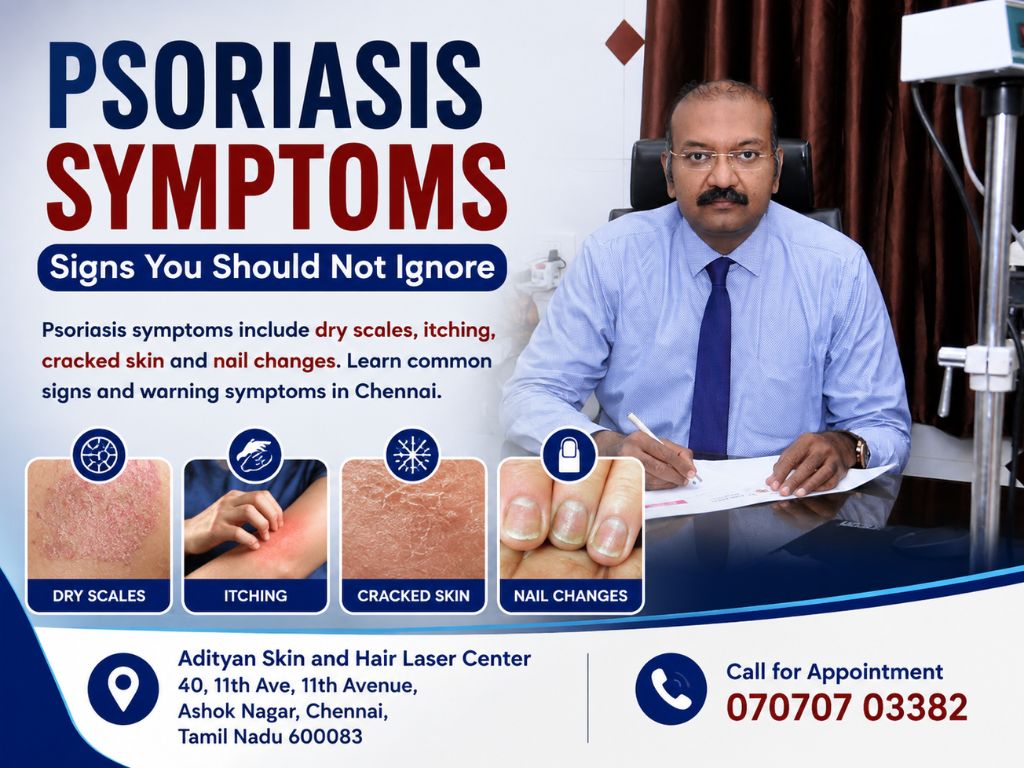
Psoriasis symptoms can look different from one person to another. Some people develop a few dry and scaly patches, while others experience widespread plaques, intense itching, burning, soreness or nail changes. Psoriasis often affects the scalp, elbows, knees and lower back, although it can appear on many areas of the body. At Adityan Skin and Hair Laser Center in Ashok Nagar, Chennai, the appearance and location of skin changes are assessed carefully because psoriasis can sometimes resemble eczema, fungal infections and other inflammatory skin conditions.
Psoriasis is a long-term inflammatory skin condition. Skin cells build up faster than usual and form thicker areas or scales on the surface. Symptoms may become more active during a flare and then improve for a period. The pattern can also vary according to the type of psoriasis, the body area affected and the person's natural skin tone.
Understanding the Main Psoriasis Symptoms
Plaque psoriasis is the most common form of the condition. It usually causes raised and thickened areas of skin covered with visible scale. These plaques often appear on the scalp, elbows, knees and lower back, but they may develop elsewhere.
Colour can also vary. On lighter skin, psoriasis may appear red or pink. On Indian and other brown skin tones, plaques may appear purple-brown, darker than the surrounding skin or grey.
Quick Answer: What Does Psoriasis Usually Look Like?
Common signs include thick or scaly patches, itching, dryness, cracking, burning and soreness. Psoriasis can also affect the scalp and nails. The exact appearance depends on the psoriasis type, body area and skin tone.
Psoriasis Symptoms You May Notice on the Skin, Scalp and Nails
Dry, Thick and Scaly Skin Patches
One of the most recognisable signs of psoriasis is a raised patch of thickened skin known as a plaque. These areas may feel rougher and thicker than the surrounding skin.
A layer of white, silver or grey scale may develop over the plaque. Some people have only a few small areas, while others develop larger patches that join together.
Itching Can Range From Mild to Intense
Itching is a common psoriasis symptom. For some people, it causes only occasional irritation. For others, repeated itching can become one of the most uncomfortable parts of the condition.
The urge to scratch may increase when plaques become very dry or inflamed. Scratching can damage the skin and may create tiny breaks, bleeding or additional irritation.
Burning, Soreness and Pain
Psoriasis does not always feel itchy. Some people describe a burning, stinging or sore feeling around active plaques.
Pain can become more noticeable when the skin cracks or when psoriasis affects high-friction areas such as the palms, soles or body folds.
Dry or Cracked Skin That May Bleed
Psoriasis can make affected skin extremely dry. As plaques become thicker, small cracks may develop.
Deep cracks can become painful and may occasionally bleed. Hands, feet, elbows and knees can become particularly uncomfortable because these areas move frequently.
Scaling
White, silver or grey flakes may form over thickened areas of psoriasis-prone skin.
Itching
Itching may range from mild irritation to repeated intense discomfort during a flare.
Cracked Skin
Very dry plaques may split and become painful, especially on hands, feet, elbows or knees.
Nail Changes
Nails may develop small pits, colour changes, thickening or separation from the nail bed.
Common Psoriasis Symptoms Compared
| Psoriasis Symptom | What It May Look or Feel Like |
|---|---|
| Thick plaques | Raised areas of thickened skin with visible scale |
| Scaling | White, silver or grey flakes over affected skin |
| Itching | Mild irritation to intense repeated itching |
| Burning or soreness | Warm, painful, tender or stinging sensation |
| Cracked skin | Dry skin that splits and may occasionally bleed |
| Scalp changes | Thick flakes or plaques around the scalp and hairline |
| Nail changes | Pitting, colour changes, thickening or separation |
| Guttate spots | Multiple small drop-shaped scaly patches |
| Skin-fold psoriasis | Smooth, inflamed areas with less visible scale |
Scalp Psoriasis Symptoms
Scalp psoriasis can range from mild flaking to thick plaques. Mild symptoms may initially look similar to dandruff.
Psoriasis scales may become thicker and can extend beyond the hairline onto the forehead, behind the ears or toward the neck. Intense scratching or forceful scale removal may also contribute to temporary hair shedding.
Nail Psoriasis Symptoms
Psoriasis can affect both fingernails and toenails. Small dents known as pits may appear on the nail surface.
Nails may also develop yellow or brown colour changes, become thicker or begin separating from the nail bed. These changes can sometimes resemble a fungal nail infection, which is why correct identification matters.
Guttate Psoriasis Symptoms
Guttate psoriasis looks different from the thick plaques commonly associated with plaque psoriasis. It often causes many small, drop-shaped scaly spots.
The spots commonly appear on the chest, back, arms or legs and may occur in children or younger adults.
Inverse Psoriasis Symptoms
Inverse psoriasis appears in areas where skin touches skin, such as the armpits, groin, under the breasts or around the buttocks.
The affected areas can look smooth and inflamed rather than heavily scaly. Sweat and friction may make the symptoms more uncomfortable.
Pustular Psoriasis Symptoms
Pustular psoriasis is less common. It may cause painful areas with clearly defined pus-filled bumps or blisters.
The surrounding skin may become swollen, tender or darker. Some forms mainly affect the palms and soles.
How Psoriasis Symptoms Can Look Different on Indian Skin
Psoriasis is often shown online as bright red plaques with white scales. However, this appearance does not represent every skin tone.
On Indian and other brown skin tones, active psoriasis may look dark brown, purple-brown or grey. Scale may appear grey or silvery rather than bright white.
Dark Marks Can Remain After a Flare
After active inflammation improves, the affected area may remain darker or lighter than nearby skin for some time.
This colour difference does not always mean that the psoriasis is still active. Skin tone often needs time to become more even after inflammation settles.
Psoriasis Symptoms Can Come and Go
Psoriasis often follows a flare-and-remission pattern. Symptoms may become more active for several weeks and then become much calmer.
Possible triggers can include stress, infections, skin injury and certain medicines. Triggers are not identical for everyone, so noticing individual patterns can help with long-term management.
Psoriasis Is Not Contagious
Psoriasis does not spread from one person to another through touch. You cannot catch psoriasis by sharing clothes, sitting near someone or using the same swimming pool.
This is important because visible plaques can sometimes cause unnecessary concern among other people.
When Psoriasis Symptoms Need More Attention
Symptoms deserve closer assessment when plaques become widespread, very painful, difficult to control or repeatedly disturb sleep because of intense itching.
Cracked bleeding skin, extensive scalp involvement, pus-filled areas or significant nail changes should also not be ignored.
Joint Symptoms Can Also Matter
Some people with psoriasis can develop joint symptoms. Pain, swelling, stiffness or prolonged morning stiffness may affect fingers, toes, knees, ankles or other joints.
Skin and joint symptoms do not always begin at the same time. New joint discomfort in a person with psoriasis therefore deserves attention.
Why Correct Identification Matters
Psoriasis can sometimes resemble eczema, fungal infection, dandruff or other inflammatory skin conditions.
Using random creams without understanding the condition may temporarily change its appearance without properly addressing the problem.
A skin assessment can help identify the pattern, scaling, body areas involved and severity before treatment is planned.
Daily Skin Care Can Influence Psoriasis Symptoms
Gentle skin care can help reduce unnecessary dryness and irritation. Very hot water, strong soaps, rough scrubbing and repeated scratching may make sensitive psoriasis-prone skin more uncomfortable.
Regular moisturising can support the skin barrier and reduce dryness. Comfortable bathing habits and avoiding known triggers may also make flare-ups easier to manage.
Psoriasis Care at Adityan Skin and Hair Laser Center
At Adityan Skin and Hair Laser Center in Ashok Nagar, Chennai, psoriasis care begins by assessing the appearance, location, duration and severity of the skin changes.
Scalp symptoms, nail involvement, itching, pain and possible triggers can provide additional information. Treatment can then focus on controlling inflammation, scaling and discomfort while supporting long-term management.
Learn more about skin and hair services through the Adityan Skin and Hair Laser Center Ashok Nagar website.
For general information about the medical speciality dealing with skin, hair and nail conditions, read this overview of dermatology.
Frequently Asked Questions
1. What are the first symptoms of psoriasis?
Early symptoms may include small dry or scaly patches, itching and areas of thicker skin. The appearance can vary according to psoriasis type, body area and skin tone.
2. Can psoriasis cause severe itching?
Yes. Psoriasis can cause mild to intense itching. Repeated scratching may damage the skin, increase irritation and sometimes cause small areas of bleeding.
3. Does psoriasis always have white scales?
No. Scale colour can vary. It may appear silver-white on lighter skin and grey or silvery on brown skin. The underlying plaques may also look purple-brown or dark rather than bright red.
4. Can psoriasis affect the nails?
Yes. Nail psoriasis may cause pitting, discoloration, thickening, crumbling or separation of the nail from the nail bed.
5. Can psoriasis symptoms disappear completely?
Psoriasis may become much less active for periods of time. However, it is generally a long-term condition, so symptoms and flare-ups can return later.
Visit Adityan Skin and Hair Laser Center – Ashok Nagar
For recurring dry patches, scalp scaling, itching, cracked skin, nail changes or other possible psoriasis symptoms, visit Adityan Skin and Hair Laser Center in Ashok Nagar, Chennai.
Clinic Address
Adityan Skin and Hair Laser Center
40, 11th Ave, 11th Avenue,
Ashok Nagar, Chennai,
Tamil Nadu 600083
Phone:
070707 03382
Recognising psoriasis symptoms early can help distinguish psoriasis from ordinary dry skin, dandruff, eczema or fungal infection. The appearance can vary across skin tones and body areas, so the pattern of scaling, itching and associated symptoms matters.