

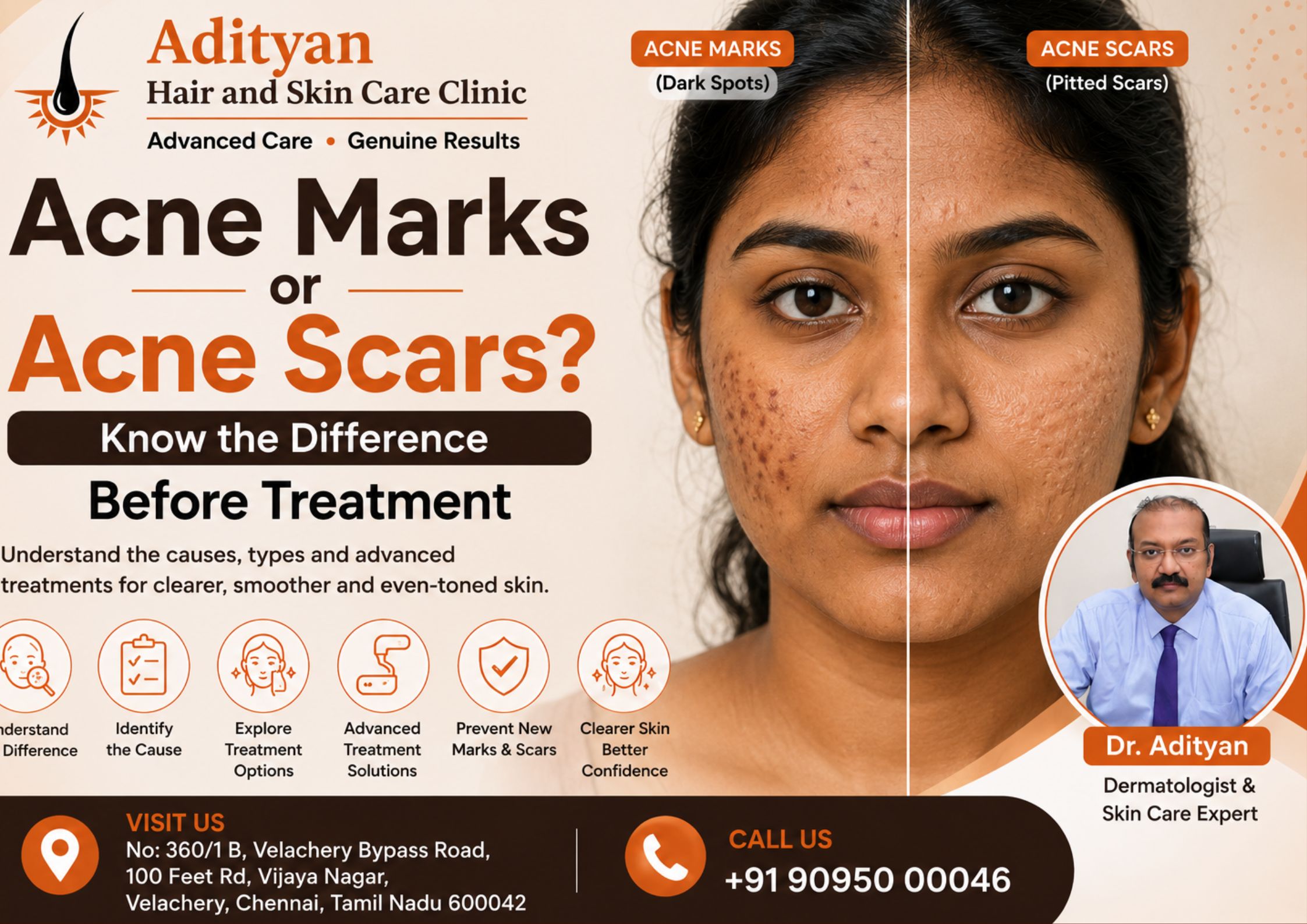
Acne marks and acne scars are common concerns that may remain even after active pimples have settled. Dark marks can make the skin look uneven, while deeper scars can change the skin’s texture and affect confidence. Many people try fairness creams, harsh scrubs or home remedies without knowing whether they have temporary pigmentation or permanent scar tissue. At Adityan Hair and Skin Care Clinic in Velachery, Chennai, the skin is carefully assessed to identify the type, depth and likely cause of the concern before a suitable treatment plan is created.
Acne does not always end when a pimple disappears. Inflammation beneath the surface may leave brown, red, grey or purple areas. Severe acne can also damage collagen, the natural protein that supports firm and smooth skin. Knowing whether the remaining concern is colour change or structural damage is important because each condition needs a different treatment approach.
Understanding Acne Marks and Acne Scars Before Treatment
Acne marks are usually flat areas of colour that remain after pimples heal. They do not normally create holes or uneven texture. They may appear brown, black, red or purple depending on the person’s skin tone, inflammation level and healing response. These marks are commonly described as post-inflammatory pigmentation.
Acne scars affect the structure of the skin. They may appear as deep pits, shallow depressions, uneven waves or raised areas. Scars form when deep inflammation damages the supporting layers and the body produces too little or too much collagen during healing.
A simple way to understand the difference is to look at the skin from the side. If the surface remains smooth but the colour is darker, it is more likely to be an acne mark. If light creates shadows because the skin has pits, waves or raised areas, it is more likely to be an acne scar.
Why Acne Marks and Acne Scars Develop
Acne marks develop when inflammation triggers the skin to produce extra pigment. Indian skin tones can develop visible pigmentation after acne, particularly when pimples are squeezed, scratched or repeatedly touched. Sun exposure may make these areas darker and cause them to remain visible for longer.
Using harsh scrubs, strong home remedies or unsuitable products may irritate healing skin and increase pigmentation. Some mild marks gradually fade, but the process can take several months. Their duration depends on pigment depth, skin type, acne severity, sun exposure and daily skincare habits.
Scars usually form after deep or severe acne. Nodules and cysts can damage the skin’s supporting tissue. When the body repairs this damage, the new collagen may not match the original structure. Too little collagen may create depressed scars, while excess collagen may create raised scars.
Delayed acne treatment, repeated breakouts and pimple squeezing increase the risk of scarring. Treating active acne early is therefore important because every new inflamed lesion has the potential to leave another mark or scar.
Common Types of Acne Scars
Ice-pick scars are narrow and deep, often resembling small holes. Boxcar scars are wider depressions with more defined edges. Rolling scars create a wavy appearance because bands of scar tissue pull the skin downward.
Raised scars are less common on the face but may appear on the chest, shoulders, jawline or back. Post-acne pigmentation may also exist together with structural scars, making the skin look both darker and uneven.
Many patients have a mixture of scar types. This is why one procedure may not improve every area equally. A detailed assessment helps identify which concern is dominant and which treatment can be used safely.
Acne Marks and Acne Scars Comparison
| Acne Marks | Acne Scars |
|---|---|
| Usually appear as flat areas of brown, red, grey or dark pigmentation. | Usually change the surface, depth or texture of the skin. |
| Develop when inflammation stimulates excess pigment production. | Develop when deeper acne damages collagen and supporting tissue. |
| May gradually fade with time, sun protection and suitable care. | Usually require procedures that stimulate or remodel collagen. |
| Often become darker after sunlight or repeated irritation. | May look more visible under side lighting because of shadows. |
| Treatment focuses on pigmentation control and skin renewal. | Treatment focuses on scar release and textural improvement. |
Treatment Options for Acne Marks and Acne Scars
Treatment for acne marks depends on their colour, depth, duration and the patient’s skin type. Dermatology-guided topical products may help reduce excess pigment and support gradual renewal. Chemical peels may be considered for selected patients to improve superficial pigmentation and uneven tone.
Laser-based pigmentation procedures may be advised when marks are resistant or located deeper within the skin. Sun protection remains essential because ultraviolet exposure can darken pigmentation and delay improvement. Active pimples should also be controlled so that new marks do not appear while older ones are being treated.
Acne scar treatment focuses on stimulating collagen and releasing scar tissue. Microneedling may be used to create controlled stimulation that supports collagen renewal. Fractional laser procedures may help improve texture by encouraging deeper repair.
Subcision may be used for rolling scars that are attached to tissue below the skin. Narrow and deep scars may require targeted procedures rather than full-face treatment alone. Combination treatment is often useful because different scar types respond to different methods.
Why One Treatment Does Not Suit Everyone
Two people with similar-looking scars may need different treatment plans. Skin tone, scar depth, active acne, pigmentation tendency, previous procedures and healing response all influence the decision.
Treating pigmentation too aggressively may irritate sensitive skin, while using only surface treatments may not improve deeper scars. A step-by-step plan allows the skin to heal between sessions and reduces unnecessary irritation.
Realistic expectations are also important. Acne scars can often be reduced significantly, but complete removal may not always be possible. The aim is smoother texture, softer scar edges, a more even-looking tone and improved confidence.
Daily Care for Acne-Prone and Scarred Skin
Gentle cleansing helps remove oil, sweat and impurities without damaging the natural barrier. A suitable moisturiser supports healing and may reduce irritation caused by acne treatments. Daily sunscreen helps prevent marks from becoming darker.
Picking, scratching or squeezing pimples should be avoided because these habits increase inflammation and raise the risk of pigmentation and scarring. Harsh scrubs cannot remove deep scars and may worsen redness.
New products should be introduced slowly, especially when medical treatments are already being used. Consistency is generally more useful than frequently changing products based on online trends.
Why Choose Adityan Hair and Skin Care Clinic?
At Adityan Hair and Skin Care Clinic, treatment begins with an assessment of active acne, pigmentation, scar type, skin sensitivity and previous treatment history. This helps create a personalised plan instead of using the same procedure for every patient.
The clinic focuses on controlling active acne while improving existing marks and scars. Regular follow-ups allow the treatment to be adjusted according to how the skin responds. Learn more about available skin and hair services by visiting the Adityan Skin and Hair Clinic website.
For a broader understanding of the medical field that focuses on skin, hair and nail conditions, read this overview of dermatology.
Frequently Asked Questions
1. Do acne marks fade naturally?
Some mild acne marks may fade gradually, but deeper pigmentation may remain for several months. Daily sun protection and suitable treatment can support more even-looking skin.
2. Can acne scars be removed completely?
Complete removal may not always be possible, but the depth, visibility and texture of many scars can be improved significantly with an appropriate treatment plan.
3. Are acne marks and acne scars the same?
No. Acne marks are usually flat areas of pigmentation, while acne scars alter the texture, depth or structure of the skin.
4. How many treatment sessions are needed?
The number of sessions depends on the type and depth of the scar, skin response and the procedure selected. Mixed or deep scars may need multiple sessions.
5. Can old acne scars still be treated?
Yes. Older scars may still respond to collagen-stimulating, laser and scar-release procedures, although the treatment approach depends on their type and depth.
6. Should active acne be controlled before scar treatment?
Yes. Controlling active acne is important because fresh breakouts can create new pigmentation and scars while existing areas are being treated.
Visit Adityan Hair and Skin Care Clinic – Velachery
For personalised treatment for active acne, post-acne pigmentation and different types of acne scars, visit Adityan Hair and Skin Care Clinic in Velachery, Chennai.
Clinic Address
No: 360/1 B, Velachery Bypass Road,
100 Feet Road, Vijaya Nagar,
Velachery, Chennai, Tamil Nadu 600042
Phone:
+91 90950 00046