

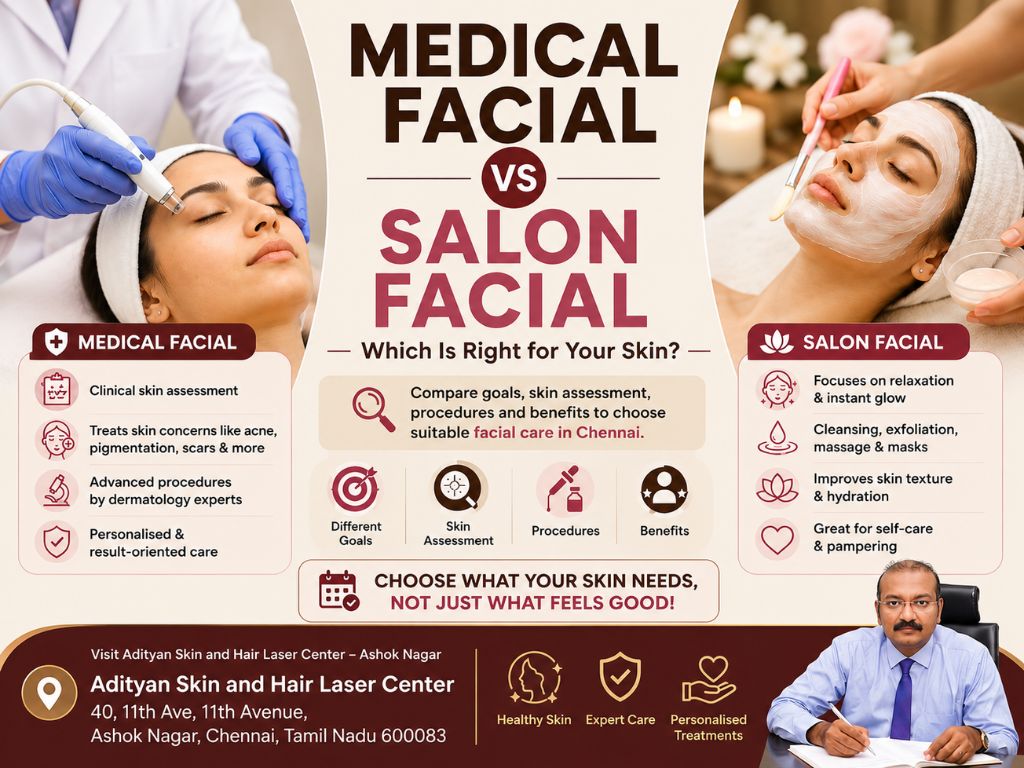
The medical facial vs salon facial difference becomes important when you want more than temporary freshness and need skincare that considers the actual condition of your skin. Both options can have a place in a skincare routine, but they serve different purposes. A salon facial commonly focuses on cleansing, exfoliation, hydration, relaxation and improving how the skin looks immediately. A dermatologist-guided facial takes a more treatment-focused approach and may address concerns such as acne, pigmentation, clogged pores or uneven texture. At Adityan Skin and Hair Laser Center in Ashok Nagar, Chennai, the skin is assessed before deciding which type of procedure may be suitable.
The term medical facial can mean different things at different clinics. The name of the facial alone does not tell you exactly what treatment you will receive. What matters more is who assesses the skin, which procedure they select, why they select it and whether it matches your skin type and concern.
Medical Facial vs Salon Facial: What Is the Main Difference?
A salon or spa facial is generally a non-invasive cosmetic service. It can include cleansing, steaming, exfoliation, facial massage, masks, moisturising and other steps that improve the way the skin looks and feels.
A medical facial focuses more on a specific skin concern. Depending on the condition, treatment may include professional cleansing, controlled exfoliation, suitable extraction, selected peels or other dermatologist-guided procedures.
The Simple Difference
A salon facial mainly supports cosmetic maintenance, relaxation and temporary freshness. A medical or dermatologist-guided facial focuses more on skin assessment and choosing treatment according to concerns such as acne, pigmentation, clogged pores or uneven texture.
Why Medical Facial vs Salon Facial Depends on Skin Assessment
Two people can both complain of dull-looking skin while having completely different concerns. One person may have simple dehydration, while another may have acne, pigmentation, sensitive skin or sun-related changes.
A proper skin assessment helps identify what is actually happening before a procedure begins. This matters because a treatment that suits oily, congested skin may not suit dry or irritated skin.
What Usually Happens During a Salon Facial?
Salon facial packages vary. A typical session often starts with cleansing to remove surface oil, makeup and impurities. The therapist may then exfoliate the skin to remove some dead surface cells.
The facial may also include steam, massage, a mask and moisturiser. These steps mainly focus on cosmetic maintenance, relaxation and making the skin feel fresh and hydrated.
For someone with generally healthy skin who mainly wants relaxation or temporary freshness, a salon facial can be a reasonable option.
What Can a Medical Facial Include?
There is no single medical facial that suits every person. The treatment should depend on the condition of the skin and the goal of the procedure.
A dermatologist-guided facial may involve controlled cleansing, exfoliation, hydration or targeted pore care. For selected concerns, a chemical peel or another professional procedure may form part of a wider treatment plan.
The treatment strength should match the patient's skin rather than following the same facial package for everyone.
Medical Facial Focus
Medical facials generally focus on assessing the skin and selecting procedures according to a specific concern. Treatment may support care for acne, pigmentation, clogged pores or uneven skin texture when appropriate.
Salon Facial Focus
Salon facials generally focus on cleansing, hydration, cosmetic maintenance and relaxation. They may provide temporary softness and freshness when the skin does not have an active medical concern.
Medical Facial vs Salon Facial Comparison
| Factor | Medical / Dermatologist-Guided Facial | Salon Facial |
|---|---|---|
| Main purpose | Treatment-focused skincare based on a specific concern | Cosmetic maintenance, freshness and relaxation |
| Skin assessment | May include clinical evaluation of skin concerns | Usually focuses on cosmetic skin type and appearance |
| Suitable concerns | May support acne, pigmentation, clogged pores or uneven texture depending on assessment | Commonly selected for cleansing, hydration and temporary glow |
| Procedures | May include controlled peels, extraction or other selected procedures | Usually cleansing, exfoliation, massage, masks and moisturising |
| Treatment strength | Chosen according to skin type and concern | Usually focuses on non-invasive cosmetic care |
| Active skin concerns | Skin can be assessed before selecting the procedure | Does not replace treatment for an active skin condition |
| Follow-up | May form part of a wider skincare treatment plan | Usually scheduled according to cosmetic preference |
This comparison does not mean that every medical facial is automatically better than every salon facial. The right choice depends on your skin, your goal and whether you have an active skin concern.
Medical Facial vs Salon Facial for Acne, Pigmentation and Texture
People with acne often assume that deeper cleansing or stronger exfoliation will automatically clear breakouts. Acne is more complex than surface dirt and can include blackheads, whiteheads, inflamed pimples, nodules and cysts.
A treatment-focused approach begins by understanding the type and severity of the acne. The same principle applies to pigmentation because dark spots can develop after acne, sun exposure, irritation or melasma.
Can a Medical Facial Help With Acne?
A medical facial may support an acne treatment plan when the selected procedure suits the type of acne. However, no facial should be considered a universal cure for breakouts.
For persistent, painful or scar-forming acne, controlling new breakouts becomes more important than achieving temporary post-facial brightness.
What About Acne Scars?
Acne scars need a different approach from active acne. Deep scars change the structure and texture of the skin, so a normal facial cannot simply wash or exfoliate them away.
Depending on the scar type, treatment may involve procedures such as chemical peels, laser-based treatments, microneedling or other scar-focused methods.
Different scar types may also require different procedures rather than one treatment for the entire face.
Medical Facials for Pigmentation
Pigmentation should be identified before treatment because not all dark areas develop for the same reason. Post-acne marks, sun-related pigmentation and melasma can require different approaches.
A treatment that works well for one type of pigmentation may irritate another condition. Sun protection can also play an important role because ultraviolet exposure may make dark spots more visible.
Are Medical Facials Suitable for Indian Skin?
Indian skin can respond well to carefully selected procedures, but treatment strength matters. Brown skin can sometimes develop post-inflammatory hyperpigmentation after excessive irritation.
This means the treated area may become darker after inflammation or injury. The procedure should therefore match the patient's skin tone, sensitivity and pigmentation tendency.
Stronger Does Not Always Mean Better
A more aggressive facial does not automatically produce better skin. Excessive exfoliation or irritation can weaken the skin barrier and may worsen sensitivity or pigmentation. The treatment should match what the skin actually needs.
When Is a Salon Facial a Reasonable Choice?
A salon facial can be a reasonable choice when the skin is generally healthy and the main goals are relaxation, surface cleansing and temporary hydration.
You may enjoy the massage and pampering experience while the skin feels softer and refreshed afterward.
The important distinction is that a cosmetic facial should not be expected to diagnose or treat persistent acne, melasma, eczema, psoriasis or other active skin conditions.
When Should You Consider Dermatologist-Guided Skin Care?
Consider a skin assessment when you have repeated breakouts, painful acne, acne scars, persistent pigmentation, unexplained redness or recurring irritation.
Assessment can help identify the concern before a procedure is selected. It can also reduce unnecessary experimentation with strong exfoliation or repeated facials that may irritate sensitive skin.
Do You Need a Facial Every Month?
There is no rule that everyone needs a facial every month. The right interval depends on the skin condition, treatment type and reason for having the facial.
Some cosmetic facials may be scheduled according to personal preference. Procedures such as chemical peels need suitable spacing so the skin has enough time to recover.
More frequent treatment does not automatically produce healthier skin.
Why Aftercare Matters
The result does not depend only on what happens during the facial. Gentle cleansing, moisturising and sun protection can help support the skin afterward.
After stronger exfoliating treatments, following the recommended aftercare becomes even more important. Avoid adding several new active skincare products immediately after a procedure unless they form part of the recommended routine.
Why Choose Adityan Skin and Hair Laser Center?
At Adityan Skin and Hair Laser Center in Ashok Nagar, Chennai, skincare begins by understanding the patient's concerns instead of selecting a facial only from a treatment menu.
Skin type, acne activity, pigmentation, sensitivity, previous procedures and current skincare products can influence which treatment may be suitable.
For someone with active acne, the priority may be controlling breakouts. Another person may mainly need care for pigmentation, uneven texture, dryness or general skin maintenance.
Learn more about skin and hair services through the Adityan Skin and Hair Laser Center Ashok Nagar website.
For general information about the medical field focused on skin, hair and nail care, you can also read this overview of dermatology.
Frequently Asked Questions
1. Is a medical facial better than a salon facial?
Neither option is automatically better for everyone. A salon facial may suit someone who mainly wants relaxation and cosmetic maintenance. A dermatologist-guided facial may be more relevant when a specific skin concern needs assessment and targeted care.
2. Can a salon facial treat acne?
A salon facial may cleanse and hydrate the skin, but persistent or severe acne often needs a more targeted treatment approach. Painful acne or acne that leaves scars should not be managed only with cosmetic facials.
3. Can medical facials remove pigmentation permanently?
No facial can promise permanent removal of every type of pigmentation. Results depend on the cause, depth of pigment, skin type, sun exposure and treatment selected.
4. Can sensitive skin have a medical facial?
Sensitive skin may be able to undergo selected procedures, but the treatment needs careful planning. Strong exfoliation, fragrances or aggressive procedures may irritate already sensitive skin.
5. How do I choose the right facial for my skin?
Start with your goal and skin condition. If you mainly want relaxation and temporary freshness, a cosmetic facial may suit you. If you have recurring acne, pigmentation, scars, redness or another ongoing concern, a skin assessment can help guide the choice.
Visit Adityan Skin and Hair Laser Center – Ashok Nagar
For personalised skin assessment and treatment guidance for acne, pigmentation, texture, sensitivity and facial care, visit Adityan Skin and Hair Laser Center in Ashok Nagar, Chennai.
Clinic Address
Adityan Skin and Hair Laser Center
40, 11th Ave, 11th Avenue,
Ashok Nagar, Chennai,
Tamil Nadu 600083