

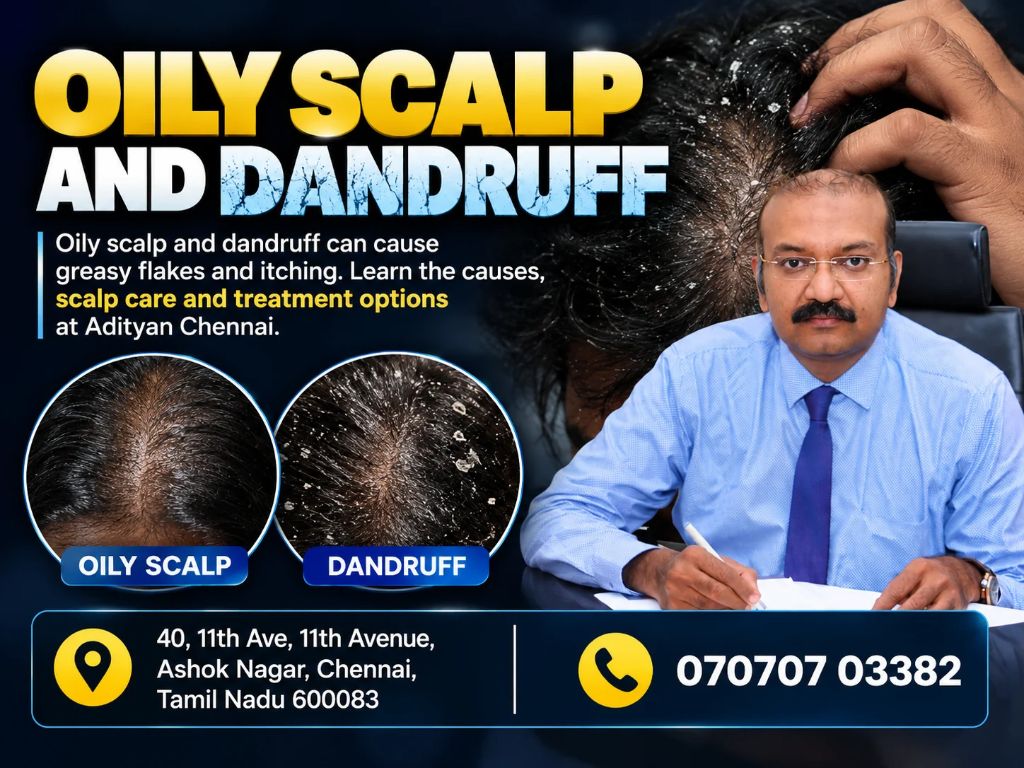
Oily Scalp and Dandruff: Why Your Scalp Feels Greasy and Flaky
Oily scalp and dandruff often appear together, leaving the scalp feeling greasy, itchy and uncomfortable while visible flakes collect between the hair or fall onto the shoulders. Many people assume dandruff happens only when the scalp is dry, but excess oil can also be associated with dandruff and seborrheic dermatitis. At Adityan Skin and Hair Laser Center in Ashok Nagar, Chennai, understanding whether the problem is simple dandruff, an oily scalp, seborrheic dermatitis or another scalp condition can help guide the right scalp-care approach.
An oily scalp does not automatically mean that a person has poor hygiene. Natural oil, known as sebum, is produced by glands in the skin and helps protect the scalp and hair. Problems may develop when excess oil combines with dead skin cells, product buildup and scalp inflammation. This can make flakes more noticeable and may increase the urge to scratch.
What Is the Connection Between Oily Scalp and Dandruff?
Dandruff is a common scalp condition that causes flaking and often itching. Irritated, oily skin can be associated with dandruff. Dandruff is also closely related to seborrheic dermatitis, a condition that commonly affects oil-rich areas of the skin.
Seborrheic dermatitis can produce greasy patches with white or yellow scales, scalp inflammation and persistent flaking. A yeast called Malassezia, which normally lives on the scalp, may also be involved. The condition is more complex than simply having too much oil because scalp microorganisms and an individual's inflammatory response may also play a role.
Quick answer: A greasy scalp does not protect against dandruff. Excess oil can occur together with flaking and inflammation, particularly in conditions such as seborrheic dermatitis. This is why simply trying to dry out the scalp may not solve recurring flakes.
Why Do Oily Scalp and Dandruff Occur Together?
Sebaceous glands naturally produce sebum to support the skin barrier. The amount of oil produced differs from person to person. Someone with naturally oily skin may notice that the scalp becomes greasy relatively quickly after washing. Hair texture, scalp condition, cleansing habits and styling products can also influence how oily the scalp feels.
Heavy use of hair gels, sprays, serums and other styling products may contribute to buildup. When residue combines with oil and dead skin cells, the scalp can feel heavier and greasier and flakes may become more noticeable.
In Chennai's warm conditions, sweating can make an already greasy scalp feel even more uncomfortable. However, sweat and dandruff are not the same problem, so recurring flakes should not automatically be blamed on hot weather.
What Does Oily Dandruff Look Like?
Oily dandruff may look different from the very fine flakes that people often associate with a dry scalp. The flakes may appear white or yellowish and can stick to oily hair or directly to the scalp. Itching and greasy-looking areas may also occur.
When seborrheic dermatitis is involved, the scalp can become more inflamed and the scaling may be persistent. However, every flaky scalp should not automatically be labelled as dandruff. Psoriasis, eczema, sensitivity to hair products and some scalp infections can produce symptoms that initially look similar.
Oily Scalp vs Oily Dandruff vs Dry Scalp
| Feature | Oily Scalp | Oily Dandruff | Dry Scalp |
|---|---|---|---|
| Main appearance | Hair and scalp become greasy | Greasy scalp with visible flakes | Scalp feels dry with fine flaking |
| Flakes | May not always be present | White or yellowish flakes may occur | Fine, dry-looking flakes may occur |
| Itching | May or may not occur | Common in many cases | Can occur |
| Oil level | Higher | Often higher or associated with oily areas | Usually lower |
| Possible concern | Excess oil and buildup | Dandruff or seborrheic dermatitis | Dryness or irritation |
| General care focus | Appropriate cleansing | Control oil, flakes and inflammation | Gentle cleansing and moisture balance |
This comparison is a general guide rather than a diagnostic test. Different scalp conditions can overlap, so persistent symptoms may need a closer assessment based on the appearance of the flakes, inflammation, itching and other scalp changes.
Can Washing Too Little Make Oily Dandruff Worse?
When a greasy scalp is not cleansed often enough for its individual needs, oil, dead skin cells and styling-product residue can accumulate. Regular washing can help remove excess oil and buildup from the scalp.
People with naturally oily scalps may need to shampoo more frequently than people with dry hair and scalp. However, this does not mean everyone with dandruff should wash their hair several times every day. The goal is to keep the scalp adequately clean without creating unnecessary irritation.
Can Washing Too Much Irritate the Scalp?
Aggressive washing is not necessarily better. Using very harsh products, scratching the scalp during washing or constantly changing shampoos can irritate sensitive skin.
A cleansing routine should therefore match the person's scalp condition and hair type. If the scalp becomes noticeably more itchy, irritated or uncomfortable after using a particular product, continuing to use it simply because it is marketed for dandruff may not be helpful.
Does Applying Hair Oil Help Oily Dandruff?
Applying more oil to an already greasy and flaky scalp does not necessarily address the underlying cause of dandruff. Hair oil may make the hair shaft feel smoother for some people, but the hair shaft and scalp have different needs.
Dandruff associated with seborrheic dermatitis involves more than simply having a dry scalp. If repeated oiling makes the scalp feel heavier, greasier or itchier, adding more oil is unlikely to resolve the underlying problem. The focus should instead be on identifying why the scalp is scaling and becoming inflamed.
How Can Oily Scalp and Dandruff Be Controlled?
Managing a greasy, flaky scalp usually starts with appropriate cleansing and targeted dandruff control. Medicated anti-dandruff shampoos may contain ingredients such as ketoconazole, selenium sulfide, salicylic acid or other dandruff-control ingredients. Different products work in different ways, so the choice depends on the scalp condition.
How the shampoo is used also matters. Some anti-dandruff shampoos need to remain on the scalp for a few minutes before being rinsed rather than being applied and immediately washed away. Product directions should therefore be followed carefully. The shampoo should primarily reach the scalp because that is where the condition is occurring.
For more information about scalp, skin and hair care, visit the Adityan Skin and Hair Laser Center Ashok Nagar website. For general background about the medical specialty concerned with skin, scalp, hair and nail disorders, you can also read this dermatology reference.
Can Oily Dandruff Cause Hair Fall?
Dandruff and seborrheic dermatitis do not normally cause permanent hair loss. However, a persistently itchy and inflamed scalp may lead to frequent scratching. Aggressive scratching can irritate the scalp and physically stress the hair, so some people may notice increased shedding or breakage while their scalp is uncomfortable.
Persistent thinning should not automatically be blamed on dandruff. Pattern hair loss, temporary shedding, nutritional issues and other hair conditions can occur at the same time as a flaky scalp. If hair density is visibly changing, the hair-loss pattern itself also needs to be considered.
Why Does Dandruff Keep Coming Back?
Dandruff can be recurrent. Symptoms may improve with suitable treatment and then return later. Seborrheic dermatitis can similarly require ongoing management to keep flare-ups under control.
This does not necessarily mean a previous shampoo or treatment failed. The scalp condition itself may have a tendency to recur. Stress, fatigue and seasonal changes may also be associated with flare-ups in some people.
Common Mistakes With an Oily and Flaky Scalp
One common mistake is assuming that every visible flake means the scalp needs more oil. Another is aggressively scratching or scraping the scalp to remove scales. Both approaches can make an already irritated scalp more uncomfortable.
Constantly experimenting with strong home remedies may also irritate sensitive skin. Similarly, using several styling products on an already oily scalp can contribute to buildup. A simpler routine that focuses on suitable cleansing and targeted dandruff control is generally more practical than repeatedly adding products.
When Does Persistent Dandruff Need More Attention?
Occasional mild flaking is common, but the scalp deserves closer attention when dandruff becomes severe, repeatedly returns, does not improve with appropriate dandruff care or is accompanied by significant inflammation.
Thick scales, pain, sores, discharge, pronounced redness or colour changes, patchy hair loss and severe itching can indicate that something other than ordinary dandruff may be present. Conditions such as seborrheic dermatitis, psoriasis, eczema and some scalp infections can produce overlapping symptoms.
Oily Scalp and Dandruff Care at Adityan Ashok Nagar
At Adityan Skin and Hair Laser Center in Ashok Nagar, Chennai, an oily and flaky scalp can be assessed according to the type of flakes, level of oiliness, itching, inflammation, scalp condition and duration of symptoms.
The aim is to distinguish ordinary dandruff from seborrheic dermatitis and other conditions that may produce similar symptoms. This distinction matters because repeatedly changing shampoos without understanding the scalp problem may provide only temporary relief.
A suitable scalp-care approach can then focus on controlling flakes and irritation while keeping the scalp clean without unnecessary harsh treatment.
Frequently Asked Questions
1. Can an oily scalp cause dandruff?
Yes. Oily and irritated skin can be associated with dandruff. Seborrheic dermatitis also commonly affects oil-rich areas and can cause greasy scales, itching and persistent flaking.
2. Should I wash my hair every day if my scalp is oily?
Some people with naturally oily scalps may benefit from more frequent shampooing, but washing frequency should match the person's hair texture and scalp needs. The aim is to remove excess oil and buildup without unnecessarily irritating the scalp.
3. Why does my scalp become oily soon after washing?
Natural oil production varies between people. Hair type, scalp condition, styling products and cleansing habits can influence how quickly the scalp feels greasy. Product buildup can also make oiliness more noticeable.
4. Should I apply hair oil when I have oily dandruff?
Adding oil does not treat the underlying causes of dandruff. If the scalp is already greasy, itchy and flaky, heavy oiling may make it feel more uncomfortable. Care should focus on the actual reason for the scaling and irritation.
5. Why does my dandruff return after treatment?
Dandruff and seborrheic dermatitis can recur. Symptoms may improve and later return, so some people require an ongoing scalp-care or maintenance routine to keep recurrent flakes and irritation under control.
Visit Adityan Skin and Hair Laser Center – Ashok Nagar
For recurring dandruff, oily scalp, itching, scaling or other persistent scalp concerns, visit:
Adityan Skin and Hair Laser Center
40, 11th Ave, 11th Avenue,
Ashok Nagar, Chennai, Tamil Nadu 600083
Call: 070707 03382
Visit Adityan Ashok NagarUnderstanding Your Oily and Flaky Scalp
Understanding the relationship between scalp oil and recurring flakes helps avoid the common mistake of treating every flake as simple dryness. A greasy scalp can occur together with dandruff, and persistent oily scaling may be associated with seborrheic dermatitis. Suitable cleansing, correct use of dandruff-control products and identifying the actual scalp condition can help keep recurring symptoms under better control.