

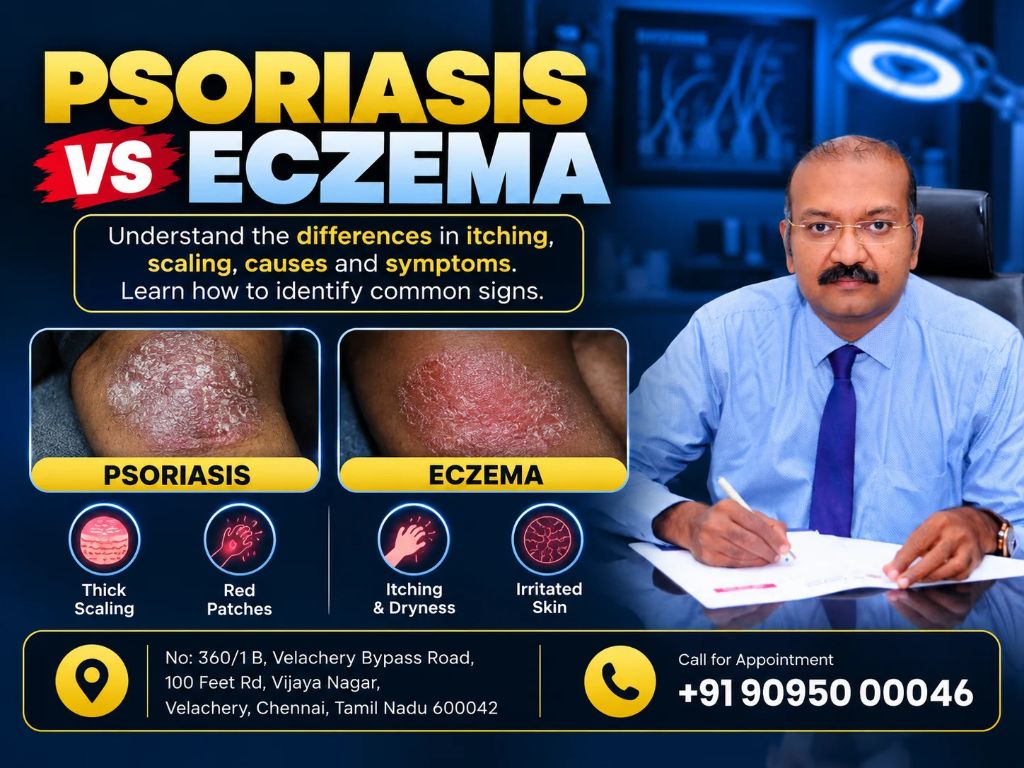
Psoriasis vs Eczema: They Look Similar, But They’re Not the Same
Psoriasis vs eczema can be difficult to understand because both conditions may cause itchy, dry, inflamed and uncomfortable skin. However, they are different skin conditions with different underlying processes, common locations, appearances and treatment approaches. Some people notice thick scaling, while others mainly experience intense itching, dryness or irritated patches. At Adityan Skin and Hair Laser Center in Ashok Nagar, Chennai, looking carefully at the appearance, location and history of recurring skin changes can help distinguish between conditions that may initially look similar.
Both conditions can affect everyday comfort. A visible rash may become frustrating when it repeatedly improves and returns. Instead of assuming that every dry patch is eczema or every scaly patch is psoriasis, understanding their typical differences can make the symptoms easier to recognise and can help you avoid unsuitable self-treatment.
What Is the Main Psoriasis vs Eczema Difference?
Psoriasis is a long-term inflammatory condition in which skin cells build up more quickly than normal. Plaque psoriasis can produce well-defined areas of thickened skin with visible scale. Eczema is a broader term for inflammatory skin conditions that commonly cause dry, itchy and irritated skin. The easiest general distinction is that psoriasis often produces thicker and more clearly defined scaly plaques, while eczema is commonly associated with strong itching, dryness and irritation.
Psoriasis frequently affects areas such as the scalp, elbows, knees and lower back. Eczema can appear in many areas and its pattern may differ depending on age, skin type and the specific form of eczema. Appearance alone, however, is not always enough to separate the two conditions.
Psoriasis vs Eczema Symptoms and Appearance
Psoriasis plaques often feel thicker than the surrounding skin and may show white, silvery or grey scaling. On lighter skin, inflammation may appear pink or red. On Indian and other brown skin tones, the affected area may instead look dark brown, purple, grey or simply deeper than the surrounding skin colour.
Eczema can produce dry, rough, itchy and inflamed patches. Repeated scratching may gradually make the affected skin thicker. During a flare, some areas may become cracked, sore or even weepy. Itching occurs in both conditions, although eczema is particularly known for intense itching and the repeated itch-scratch cycle.
Where Do Psoriasis and Eczema Commonly Appear?
The location of a rash can provide useful clues. Plaque psoriasis frequently develops on the elbows, knees, scalp and lower back. It may also involve the palms, soles, nails and skin folds. Eczema can occur almost anywhere, but adults may experience it on the hands, neck, face or skin folds depending on the type and individual triggers.
Location should never be considered the only clue because both conditions can affect overlapping body areas. This is one reason recurring or unclear rashes benefit from a complete assessment rather than identification based only on online photographs.
Psoriasis vs Eczema Comparison
| Feature | Psoriasis | Eczema |
|---|---|---|
| Typical appearance | Thick, defined plaques with visible scaling | Dry, irritated, inflamed or rough patches |
| Itching | Common and sometimes intense | Often a major symptom and can be severe |
| Scaling | Frequently thicker and more noticeable | May be dry or flaky but often less plaque-like |
| Common areas | Scalp, elbows, knees and lower back | Hands, face, neck and skin folds depending on type |
| Nail involvement | Pitting, thickening or separation can occur | Nail changes are less characteristic |
| Contagious? | No | No |
This comparison is a general guide rather than a diagnostic test. The two conditions can sometimes look surprisingly similar, particularly when inflammation has been present for a long period or when scratching has changed the appearance of the skin.
Why Does Psoriasis Happen?
Psoriasis involves the immune system and an unusually rapid cycle of skin-cell production. Genetics can influence a person's likelihood of developing the condition. Symptoms may become more active after certain triggers, and factors such as stress, infections, skin injury and some medicines can be associated with flares in susceptible people.
Psoriasis is not caused by poor hygiene and cannot be caught by touching another person's plaques. Understanding this is important because visible scaling can sometimes create unnecessary worry or social discomfort.
Why Does Eczema Happen?
Eczema can involve a combination of skin-barrier problems, immune activity, genetics and environmental factors. The skin barrier is the outer protective layer of the skin. When this barrier does not work effectively, the skin may lose moisture more easily and become more sensitive to irritants.
Triggers vary between people. Heat, sweat, soaps, fragrances, detergents, dry conditions and certain fabrics may aggravate symptoms in some individuals. Identifying personal triggers can therefore be useful, although avoiding one product or food does not automatically resolve every case.
Which Condition Itches More: Psoriasis vs Eczema?
Both conditions can itch, but intense itching is particularly characteristic of eczema. Scratching may temporarily feel relieving, yet repeated scratching can damage the skin barrier and increase inflammation. This creates a cycle where itching leads to scratching and scratching leads to further irritation.
Psoriasis can also cause significant itching, burning or soreness. Thick plaques may become dry and crack, particularly on the palms, soles, elbows or knees. The intensity of itching alone therefore cannot reliably determine which condition is present.
How Psoriasis and Eczema Can Look Different on Indian Skin
Skin inflammation is not always bright red on Indian skin. It may appear purple, grey, dark brown or deeper than a person's normal skin colour. After a psoriasis or eczema flare settles, the affected area may also temporarily remain darker or lighter than the surrounding skin.
This is an important reason not to depend completely on reference photographs showing only lighter skin tones. The colour, texture, scaling, location and history of the rash all provide useful information.
Can Both Conditions Affect the Scalp?
Yes. Psoriasis and eczema can both affect the scalp. Scalp psoriasis may produce thicker scaling and plaques that sometimes extend beyond the hairline. Eczema-related scalp inflammation can produce dryness, itching and irritation.
Other conditions, including seborrheic dermatitis and fungal infections, can also cause scalp scaling. Persistent scalp flakes should therefore not automatically be labelled as ordinary dandruff. You can learn more about skin and hair care through the Adityan Skin Clinics website. For broader background about the medical field concerned with skin conditions, see this dermatology reference.
Are Psoriasis and Eczema Contagious?
Neither psoriasis nor eczema is contagious. Touching, hugging, sharing a room or sitting beside someone with either condition does not make another person develop it. Both are inflammatory skin conditions rather than infections that spread through ordinary physical contact.
Why Correct Identification Matters
Using the same treatment for every itchy or scaly rash can create problems. A rash that appears similar to eczema may have another cause, while psoriasis may sometimes be confused with fungal infection or ordinary dry skin.
The location, thickness, scaling pattern, duration, itching and previous flare history all provide useful clues. Correct identification helps match care to the actual condition instead of repeatedly trying random creams whenever the rash returns.
Daily Skin Care for Recurring Dry and Scaly Skin
Gentle skin care can support the skin barrier when dryness and irritation are recurring problems. Very hot showers, harsh soaps and repeated scrubbing may make sensitive skin more uncomfortable. Regular moisturising can reduce dryness, while mild products can help limit unnecessary irritation.
Scratching should also be reduced where possible because repeated scratching can damage already inflamed skin. Daily care does not replace treatment directed at the specific condition, but it can form an important part of long-term management.
When Does a Recurring Rash Need More Attention?
A recurring rash deserves closer attention when it repeatedly returns, spreads, becomes painful, develops significant cracking or begins interfering with sleep and everyday activities. Thick scalp scaling, nail changes or clearly defined plaques may provide additional clues toward psoriasis. Severe itching and widespread dry inflammation may be more suggestive of eczema, although symptoms can overlap.
Sudden changes or signs such as increasing pain, warmth, pus or crusting also need careful assessment because another skin problem or a secondary infection may be present.
Psoriasis and Eczema Care at Adityan Ashok Nagar
At Adityan Skin and Hair Laser Center in Ashok Nagar, Chennai, recurring itchy, dry or scaly skin can be evaluated according to its appearance, location, duration, severity and previous flare pattern. Understanding whether the problem is consistent with psoriasis, eczema or another skin condition helps avoid treating every rash in exactly the same way.
Frequently Asked Questions
1. Which is worse, psoriasis or eczema?
There is no single answer because either condition can be mild or severe. The impact depends on the affected body area, severity of itching or pain, frequency of flares and how much the symptoms interfere with daily life.
2. Can eczema look like psoriasis?
Yes. Both can cause dry, inflamed and scaly skin. Psoriasis often forms thicker and more clearly defined plaques, while eczema is frequently associated with strong itching and dry irritation.
3. Can psoriasis and eczema occur on the scalp?
Yes. Both can involve the scalp and produce itching or scaling. Other conditions can create similar symptoms, so scalp flakes alone cannot identify the underlying cause.
4. Are psoriasis and eczema contagious?
No. Neither condition spreads from person to person through touching, sharing clothes or normal everyday contact.
5. Can psoriasis or eczema go away permanently?
Both conditions can have periods when symptoms improve significantly, but they can also recur. Long-term care generally focuses on controlling symptoms, supporting the skin barrier and reducing relevant triggers where possible.
Visit Adityan Skin and Hair Laser Center – Ashok Nagar
For recurring itchy skin, dry patches, scaling, psoriasis, eczema or other persistent skin concerns, visit Adityan Skin and Hair Laser Center.
40, 11th Ave, 11th Avenue,
Ashok Nagar, Chennai, Tamil Nadu 600083
Understanding the differences between psoriasis and eczema can make recurring skin symptoms less confusing. Psoriasis often produces thicker, clearly defined scaly plaques, while eczema commonly causes intense itching, dryness and irritated skin. Because both conditions can look different across Indian skin tones and may share similar symptoms, recognising the complete pattern is more useful than relying on a single sign.